

In the previous decade, the "Network Effect" was a sociological phenomenon. Metcalfe’s Law governed the value of a platform based on the number of nodes (people) connected: the more users on WhatsApp or Facebook, the more valuable the network became for everyone. Value was derived from the Social Fabric - the density of human connections.
As we pivot into the Agentic Era, network effects are undergoing a structural mutation. We are moving from a model of connectivity to a model of Service Transactions. In this new paradigm, value is not created by how many people you can "reach," but by how many complex, multi-step outcomes an autonomous agent can "deliver."
1. The Mechanics: From N=Users to N=Capabilities
In the app era, a "node" was a human user. In the AI era, a "node" is a Capability or a Tool API. The network effect no longer grows because of "user density," but because of interoperability density.
- App Era (Social Network Effect): (where is the number of human users).
- Agent Era (Service Network Effect): (where is the reasoning capability, and is the number of executable tools/APIs integrated).
When an agent gains the ability to use a new tool (e.g., a "Stripe" tool for payments or a "ServiceNow" tool for tickets), the value of that agent doesn't just grow linearly; it compounds. If Agent A can now pay for the services it discovers, it unlocks a whole new category of transactional outcomes that were previously impossible.
2. The Shift: Connectivity vs. Outcomes
The fundamental unit of value is shifting from the Message to the Transaction.
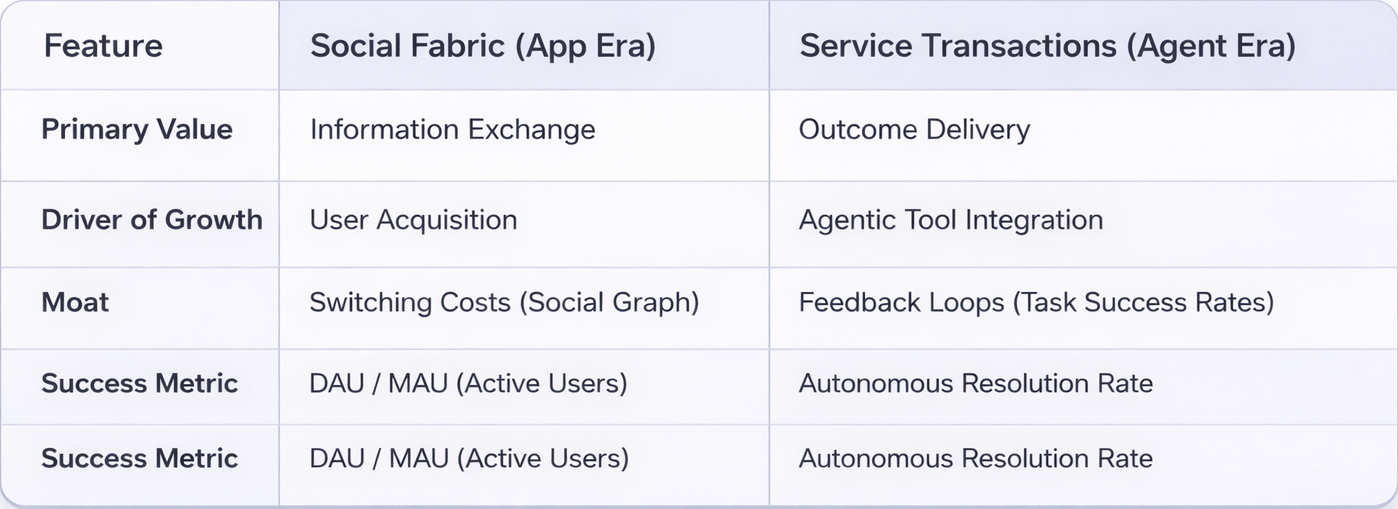
In the "Service Transaction" model, the network effect is driven by a Self-Reinforcing Success Loop. As more agents execute transactions on a platform, the platform gathers telemetry on which "tool-paths" lead to successful outcomes. This "Outcome Data" becomes the new "Social Graph." The network becomes more valuable because it is the most reliable place to get a job done, not just the place where everyone "is."
3. The "Just-In-Time" (JIT) Logic Synthesis
A key technical pillar of this new network effect is what we might call JIT Logic Synthesis. In the old model, developers wrote static code to handle specific interactions. In the Agentic Era, the "Network" itself can synthesize the logic required to bridge two services on the fly.
Imagine a web server that is given a "Goal" (e.g., "Onboard this new customer and set up their billing").
- The Agent analyzes the available backend APIs (the "Nodes").
- The JIT Agent writes the "Glue Code" to connect those APIs to meet the goal.
- The Telemetry from that execution is fed back into the network, making the next "Outcome" faster and more accurate.
This creates a Technical Network Effect: the more "Goals" the network attempts, the larger its library of "Proven Logic" becomes, making it progressively harder for a competitor to catch up.
4. The "Preferential Attachment" of Agents
In network science, "Preferential Attachment" explains why big networks get bigger. In the Agentic Economy, agents will gravitate toward "Hubs" that offer the best Negotiation Leverage.
If 1,000 "Buyer Agents" use a specific Marketplace Agent, that Marketplace Agent gains immense leverage over "Seller Agents." It can demand better pricing or faster API response times. This attracts even more Buyer Agents, creating a Winner-Take-All Transactional Loop. The "Network Effect" here isn't about being social; it's about being the most powerful economic representative in the digital layer.
Conclusion: The New Moat
The companies that won the last era (Meta, LinkedIn, Twitter) owned the Identity and the Graph. The companies that will win the AI Era will own the Outcome and the Telemetry.
We are moving away from a world where we "log in" to see what people are doing, and toward a world where we "deploy agents" to see what they can achieve. The network effect is no longer a conversation; it is a successful, high-fidelity, autonomous service transaction.